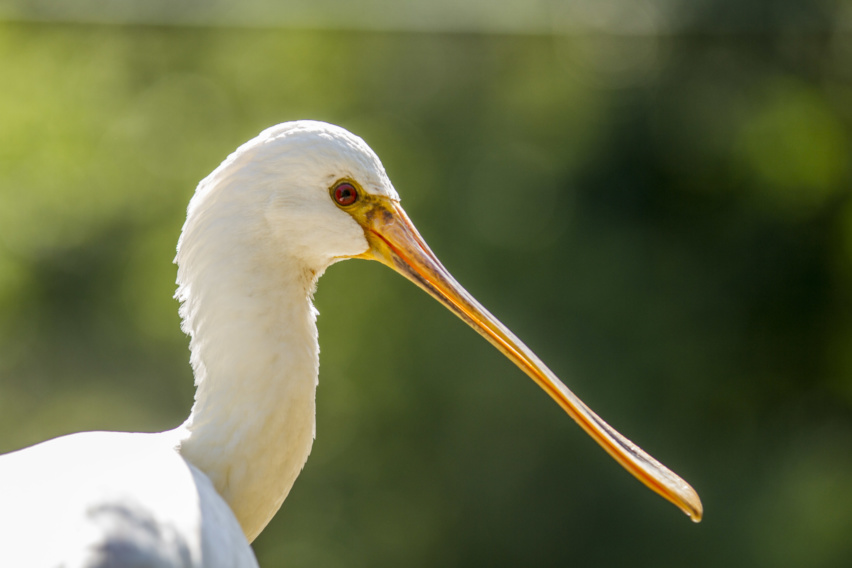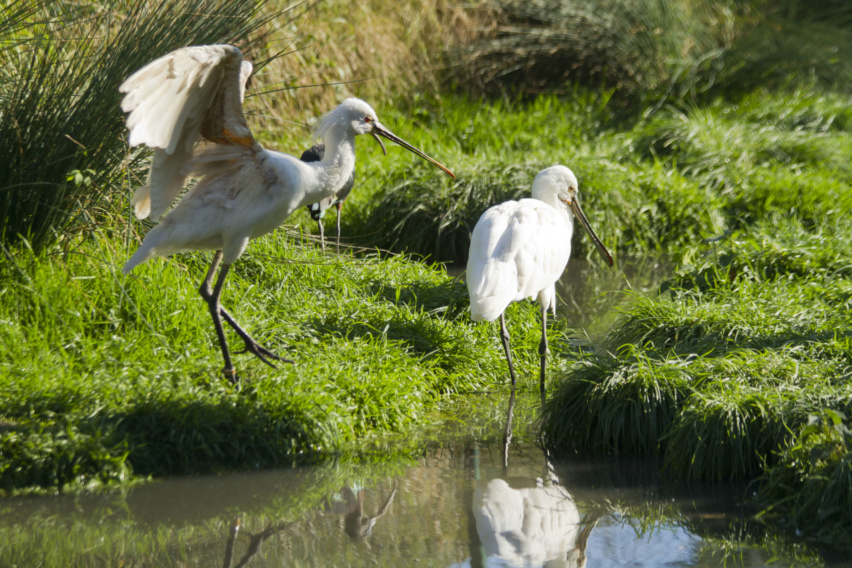

White spatula

Its beak acts as a prey detector
The Eurasian spoonbill lives near clear, shallow bodies of water: coastal wetlands, marshes with extensive reed beds, scrub, and trees, or muddy rivers.
To feed, it moves with its bill submerged in the water, sweeping its head from side to side. The broad tip of its bill is highly sensitive, allowing it to detect prey more easily. White spoonbills feed in small groups, which makes their foraging more efficient.
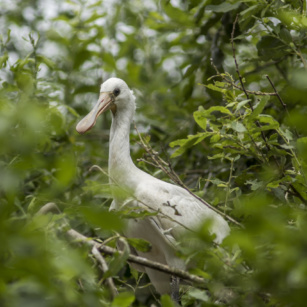
It is a migratory bird that nests in colonies in trees or in reeds.
IUCN status
The International Union for Conservation of Nature’s Red List of Threatened Species (IUCN)
Description
Platalea leucorodia
Threskiornithidae
1,2 to 1,7kg
80 to 93cm
Coastal and inland wetlands
Least Concern
20 to 25 year
Reproduction
There are approximately 6,000 pairs in Europe. During the breeding season, adults develop an orange-yellow throat and a pale yellow crest. In France, 50 pairs have settled in the Loire-Atlantique region over the past two decades, and recently, a few more have settled in the Landes region.
Did you know?
During the drought of 2003, a spoonbill came to spend a few days at the Sainte Croix ponds.
Food
The spoonbill feeds on insects, mollusks, crustaceans, small fish, amphibians, and reptiles.